

The upcoming Future Homes Standard aims to slash carbon emissions by up to 80% compared to current emissions, and create net-zero housing. It changes the very way construction companies approach building new homes in many ways, including the methods by which it’s heated.
EasyFlow have been installing underfloor heating in Shropshire, the Midlands, Wales, and the North West of England for over 10 years. Here, we unpack the Future Homes Standard, explore its impact on heating, and consider what the future holds for underfloor heating.
What is the Future Homes Standard?
The Future Homes Standard is a new UK regulation that will require the construction industry to adopt new technologies and sustainable practices when building homes. New builds will be required to have low-carbon, energy-efficient heating, improved insulation and compatibility with EV charging and renewable energy generation.
Specifically, it will change Part L and Part F of the Building Regulations, which cover insulation, energy-efficient heating and ventilation, respectively. New homes will require all forms of insulation with higher R-values to reduce heat loss and thermal bridges where heat loss can occur. Low-carbon heat sources like solar water and heat pump installations will be required, and gas boilers will be phased out.
Will the Future Homes Standard Affect Existing Homes?
It will apply to new homes or existing homes undergoing renovations covered by Part L and Part F of the Building Regulations. Older homes will not be required to conform if works do not cover heating, insulation, or ventilation.
How Does the New Standard Affect Heating?
The Future Homes Standard will phase out gas boilers and require a renewable compatible heat source, such as a biomass boiler or heat pump installation. Most low-carbon heat sources generally operate at lower flow temperatures (around 40-50°C) than gas boilers (up to 70-80°C).
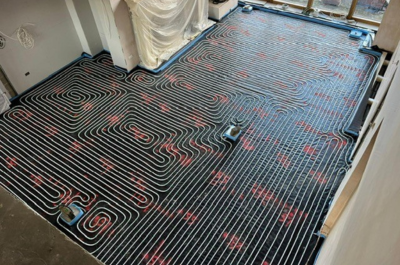
This is a big change for radiator systems, which are designed to radiate heat from very hot water. With the new standard, radiators may be less efficient. Underfloor heating, however, works optimally at lower temperatures, providing comfortable, energy-efficient heating.
Furthermore, as there is a strong emphasis on building homes with renewable energy generation capability, heating systems that can benefit from this will be at a significant advantage.
Will Underfloor Heating be a Key Component of New Builds?
Underfloor heating, both wet and electric floor heating, is very likely to be standard for new build homes and renovations covered by Part L and Part F of the Building Regulations. Furthermore, underfloor heating efficiency will benefit from better floor insulation, low-carbon heat sources, and solar power mandated by the new standard.
EasyFlow can provide a full-service bespoke installation of underfloor heating, from floor insulation to the screed and even the heat pump installation. Our designs are carefully engineered with CAD and calculations to ensure maximum heating efficiency.
Our underfloor heating’s intuitive design and heating principles make it energy-efficient heating that does not sacrifice the end user’s comfort. If you are considering developments with underfloor heating in Shropshire or further afield, get in touch with EasyFlow by calling our experienced team on 01743 343000 or emailing






Latest News