
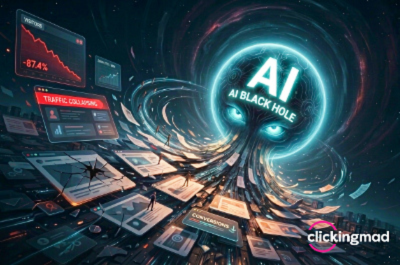
If your website traffic has fallen recently, it may not be because your rankings have dropped. It may be because Google has changed.
_______________________________________________________________________________________
Over the last year, Google has started using artificial intelligence to answer questions directly within search results. Instead of showing people a page of website links, it increasingly provides its own answer at the top of the page.
For many Shropshire businesses, this means fewer people are clicking through to websites, even when those businesses still appear prominently in search results.
The way people search is changing, and businesses need to adapt.
What is AI search?
You have probably seen it yourself. Ask Google a question and, before you see the usual list of websites, you may see a detailed answer generated by AI. You can then ask follow-up questions and continue the conversation.
This is known as AI search, AI Overviews or AI-powered search. It is changing how people discover products, services and local businesses.
For companies that rely on organic traffic from Google, it is one of the biggest changes to search engine optimisation in years.
Why does this matter?
For years, the goal was simple. Rank highly on Google. Get clicks. Generate enquiries or sales.
Today, many searches are answered before someone clicks on a website. Google is becoming the first point of information rather than simply a directory of links.
This does not mean websites are becoming less important. In fact, the opposite is true. Google's AI still needs trusted sources to learn from and reference, and the businesses providing the best information are the ones most likely to be featured.
The difference is that the quality bar has become much higher.
The question every business should ask
Here is one question every business owner should ask their current website company or SEO agency:
What impact has AI search had on our organic traffic over the last 12 months?
Many agencies are still reporting rankings, impressions and keyword positions. Those figures remain useful, but they no longer tell the whole story.
Ask them:
- Has our organic traffic increased or decreased?
- Which pages have lost the most visitors?
- Which pages have gained visibility through AI search?
- How are we adapting our content strategy?
- What is our plan for AI search optimisation?
If they cannot answer those questions clearly, it may be time for a deeper conversation.
What is working now?
The businesses performing best in AI search tend to follow the same principles.
Answer real customer questions
Think about the questions customers ask every day. How much will it cost? How long will it take? What are the risks? What are the alternatives? What happens if something goes wrong?
The more thoroughly your website answers those questions, the more valuable it becomes to both customers and search engines.
Show real experience
This is where local businesses have a huge advantage. AI can repeat information that already exists online. It cannot replicate decades of experience running a business in Shropshire.
Share examples. Explain what you have learned. Talk about the common mistakes customers make. Provide genuine insight. Real expertise is becoming one of the most valuable assets in digital marketing.
Create helpful content
The best website content is no longer written for search engines. It is written for people.
Useful guides, frequently asked questions, case studies, advice articles and practical information all help to establish authority. Google increasingly rewards content that genuinely helps users solve a problem.
Make your website easy to understand
Complicated language creates barriers. Use clear headings. Answer questions directly. Keep information up to date. Explain technical topics in plain English.
The easier your content is for people to understand, the easier it is for AI systems to understand too.
Use AI as a tool, not a replacement
AI can save time. It can help with research, proofreading and content planning. What it cannot do is replace your expertise, experience and judgement.
Businesses that rely entirely on AI-generated content often end up sounding exactly the same as everyone else. Businesses that combine AI tools with genuine expertise create content that stands out.
What does this mean for Shropshire businesses?
The opportunity is significant. Many businesses have not yet adapted their websites for AI search, and that creates an advantage for those who move early.
Whether you are a manufacturer in Telford, an accountant in Shrewsbury, a solicitor in Bridgnorth, a construction company in Oswestry or a retailer in Ludlow, the same principle applies. Customers still need answers. They still need expertise. They still need businesses they can trust.
The companies that provide those answers clearly and consistently will continue to attract enquiries, whatever happens to search technology next.
The bottom line
AI search is not the end of search engine optimisation. It is the next stage of it. Good SEO, strong website content, expert knowledge and a focus on helping customers remain as important as ever.
What has changed is that businesses can no longer rely on simply ranking for a few keywords. Today's winners are the organisations that demonstrate expertise, answer real customer questions and provide genuine value online.
If you have not yet asked how AI search is affecting your website traffic, now is probably the right time. Clickingmad can help. Call us on 01746 769612 for a friendly, jargon-free chat.
About the author
Shaun Carvill is Managing Director of Clickingmad, a Shropshire-based website design, SEO and digital marketing agency. With more than 30 years of experience helping organisations grow online, he works with businesses across the UK to improve website performance, increase enquiries and adapt to the changing world of search.



Latest News