

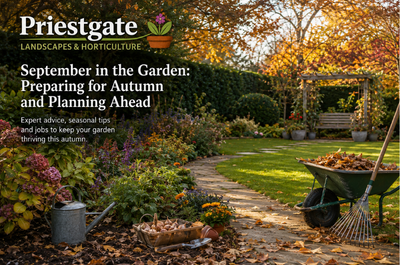
September in the Garden: Preparing for Autumn and Planning Ahead
As summer begins to draw to a close and the first signs of autumn start appearing, September brings an important change of pace in the garden. The days may be getting shorter, but this is far from the end of the gardening season. In many ways, September is one of the most useful months of the horticultural calendar.
The soil is still holding much of its summer warmth, while cooler temperatures and increasing rainfall can create excellent conditions for planting and establishing new growth. It is also the ideal time to repair some of the wear and tear caused by summer, tidy borders and lawns, and begin preparing gardens for the colder months ahead.
At Priestgate Landscapes & Horticulture, September marks the beginning of a particularly busy period of seasonal maintenance, planting, lawn care and hedge work.
A Great Time to Plant
One of the biggest opportunities September provides is planting.
While we often associate spring with putting new plants into the garden, early autumn can actually provide excellent establishment conditions for many trees, shrubs and hardy perennials.
The ground remains relatively warm, encouraging root development, while cooler air temperatures mean plants are generally under less stress than they would be during hot summer weather.
Plants established during autumn have several months to begin developing their root systems before the following growing season, helping them get off to a stronger start when spring arrives.
September is also the time to begin thinking about spring-flowering bulbs. Daffodils, crocuses, alliums and many other bulbs can be planted during autumn, providing colour at a time of year when the garden is just beginning to wake up again.
Tulips are generally better planted a little later in autumn when soil temperatures have fallen further.
Give Tired Borders Some Attention
By September, many herbaceous borders can begin looking a little tired after months of growth.
Deadheading plants that are still flowering can help extend their display, while plants that have clearly finished can gradually be cut back.
However, there is no need to make every border perfectly tidy.
Leaving selected seed heads and stems standing can provide structure and winter interest while also offering valuable food and shelter for wildlife. Seed heads from plants such as echinacea and rudbeckia can look fantastic on frosty mornings and provide food for birds.
September is also an excellent month for dividing congested herbaceous perennials.
Established clumps that have become overcrowded can be lifted, divided and replanted. This rejuvenates the original plant while providing additional plants that can be used elsewhere in the garden.
September Lawn Care
After a busy summer, lawns can often benefit from some attention.
Heat, dry weather, children, pets and general garden use can all leave lawns compacted, thin or patchy.
As temperatures become cooler and moisture levels increase, September provides a useful window for lawn renovation.
Depending on the condition of the lawn, autumn maintenance may include mowing, scarifying, aerating compacted areas, overseeding bare patches and applying an appropriate autumn lawn feed.
Aeration is particularly useful on compacted ground because it allows more air, moisture and nutrients to reach the root zone.
One important change at this time of year is feeding. High-nitrogen summer lawn feeds encourage lush leafy growth and become less appropriate as we move towards colder weather. Autumn lawn feeds are generally formulated to support root development and overall plant strength instead.
A little attention now can make a considerable difference to how a lawn performs next spring.
Hedge Cutting Season
September also brings an important opportunity for hedge maintenance.
Many established hedges will have produced substantial growth during spring and summer and can now be tidied to restore their shape before winter.
Before carrying out any hedge work, however, wildlife should always be considered. Although the main bird nesting season is generally associated with spring and summer, active nests can still be present, so hedges should always be checked before work begins.
A well-maintained hedge is much more than a boundary. Hedges provide shelter, habitat and food sources for wildlife while also contributing structure and privacy to the garden.
Don't Throw Those Leaves Away
As autumn progresses, leaves will inevitably begin falling.
Rather than simply treating them as waste, fallen leaves can become an extremely useful resource.
Leaves collected from lawns, patios and paths can be composted or turned into leaf mould. Given time to break down, leaf mould produces an excellent soil conditioner that can be incorporated into borders or used as a mulch.
Where practical, some leaves can also be left beneath hedges and in less formal areas, providing valuable habitat for insects and other garden wildlife.
The important distinction is location. Thick layers of leaves left sitting on lawns can block light and damage the grass underneath, while wet leaves on paths and patios can become slippery.
Keep an Eye on Watering
September may bring cooler and wetter weather, but recently planted trees, shrubs, hedges and perennials should still be monitored carefully.
A few showers do not necessarily mean moisture has penetrated deeply into the soil.
Plants installed during the current growing season are particularly vulnerable because their root systems have not yet spread far beyond their original root balls.
It is generally better to give newly planted specimens a thorough, deep watering less frequently rather than repeatedly wetting only the soil surface.
Containers should also continue to be checked regularly. Pots can dry surprisingly quickly even when surrounding borders appear damp.
Think About Wildlife When Tidying
The traditional approach of cutting everything down and leaving a completely bare garden for winter is increasingly being reconsidered.
Gardens provide an enormous amount of habitat.
Seed heads, hollow stems, leaf litter, hedges and dense planting can all provide shelter or food for insects, birds and other wildlife.
That doesn't mean abandoning garden maintenance. Instead, we can be more selective.
Keep lawns, paths and important areas tidy while allowing quieter corners of the garden to remain slightly more natural. It is possible to create a garden that looks cared for while still providing valuable habitat throughout autumn and winter.
Start Planning Next Year's Garden Now
September is also a good month to assess what has — and hasn't — worked during the year.
Perhaps a border lacks colour at a particular time of year. Maybe one area has become overcrowded, while another remains bare. A plant might be struggling because it is receiving too much shade, or a lawn may repeatedly suffer because of poor drainage or compaction.
These observations are extremely useful when planning improvements.
Take photographs, make notes and consider how different areas could be improved through better plant selection, soil improvement, new planting schemes or alterations to the garden's layout.
Planning now means improvements can potentially be carried out during autumn and winter, ready for the next growing season.
September Garden Checklist
Some of the key jobs to consider this month include:
- Plant spring-flowering bulbs for colour next year.
- Divide overcrowded herbaceous perennials.
- Continue deadheading plants that are still flowering.
- Cut back selected summer perennials as they finish.
- Aerate lawns and overseed bare or damaged areas.
- Carry out seasonal hedge maintenance where appropriate.
- Collect leaves for composting and leaf mould.
- Weed borders before growth slows.
- Mulch and improve soil where required.
- Continue watering recently planted trees, shrubs and containers.
- Prepare areas for autumn tree, shrub and hedge planting.
- Check stakes, ties and supports before autumn winds arrive.
- Begin planning planting and landscaping improvements for next year.
Looking After Your Garden This Autumn
A productive September isn't about putting the garden to bed as quickly as possible. It is about helping the garden make the transition from summer into autumn in the best possible condition.
The work carried out over the next few weeks can influence everything from lawn quality and plant establishment to spring flowering and the overall health of borders next year.
At Priestgate Landscapes & Horticulture, our team provides professional horticultural and landscaping services ranging from seasonal garden maintenance, hedge cutting and lawn care through to planting schemes, border renovation and larger landscaping projects.
Whether your garden simply needs an autumn tidy or you are already thinking about transforming an area ready for next year, September is an excellent time to get started.
Plan today. Plant for tomorrow. Enjoy every season.
Priestgate Landscapes & Horticulture
Landscape Maintenance | Horticultural Expertise | Garden Improvements






Latest News