
Most employers keep a reasonably close eye on sickness absence. We know roughly how many days are lost each year, what cover costs, and how statutory sick pay affects the payroll.
Far fewer of us track the time between an employee first thinking "something isn't right" and actually getting the support or treatment they need. That gap rarely appears in absence reports or management meetings. Yet for many small and medium-sized businesses, it can be one of the most expensive periods of all.
The scale of the wait
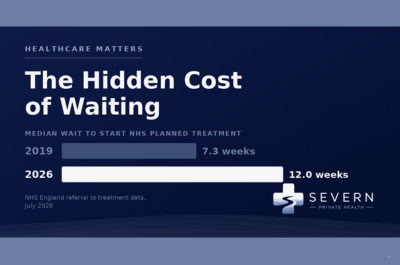
The most recent NHS England figures, covering July 2026, show 7.33 million cases on the waiting list for planned hospital treatment. The number worth holding onto, though, is the median wait: 12 weeks. That is the midpoint, so half of those waiting had been waiting longer. Before the pandemic it was 7.3 weeks.
Locally the picture is better, and that deserves recognition. The Shrewsbury and Telford Hospital NHS Trust reduced the number of patients waiting for treatment by around 30% in a single year, and cut the number waiting more than twelve months to a small fraction of the national average. Across Shropshire, Telford and Wrekin, waiting lists have fallen substantially.
However, "better" does not necessarily mean "quick". For many routine procedures, investigations and specialist appointments, waits are still measured in months rather than weeks. And the hospital waiting list is only part of the story. By the time someone appears in the NHS statistics, they have often already spent weeks deciding whether to seek help, arranging a GP appointment and waiting on referrals and diagnostic tests.
For the employee, the clock started long before the NHS one did.
What it actually costs a business
Most business owners think first about absence. Absence is certainly a cost, but it is often not the biggest one. The more significant costs are usually hidden.
Presenteeism. An employee may still be at work, but if they are struggling with pain, anxiety or uncertainty while waiting for treatment, they are unlikely to be working at their best. Productivity declines, mistakes increase, concentration suffers. Unlike absence, none of this appears on a spreadsheet.
Fragmented time off. Waiting for treatment tends to create sporadic absence rather than one clearly defined period. A morning appointment here, a consultation there, a last-minute cancellation that sends the process back to the beginning. These interruptions are considerably harder to plan around than a block of leave.
Pressure on colleagues and management. In a small business, every employee matters. If someone is unable to perform at their usual level for several months, colleagues absorb the difference, and over time that affects morale and stress elsewhere in the team. Meanwhile the return-to-work meetings, rota changes and wellbeing conversations quietly consume management capacity. Individually, none of it looks significant. Across several months, it adds up.
Delayed decisions and lost revenue. If the person affected manages customers, produces quotations or signs off on projects, delays ripple outwards quickly. Sometimes the real cost is not the treatment at all, but the opportunities that never materialise because the business could not operate at full capacity.
The national data points the same way. Across the UK in 2025, workers with a long-term health condition lost an average of 8.3 days each, compared with 2.3 days for everyone else — roughly four times as many.
A common SME scenario
Imagine a business with twelve employees. One team member develops a knee problem. It doesn't stop them working, but travelling becomes difficult and certain tasks become increasingly challenging. They carry on while waiting for appointments and treatment.
Because they are still turning up every day, the issue doesn't initially look serious. Yet over several months their productivity falls, colleagues absorb extra work, deadlines become harder to meet and customer response times begin to slip. Nobody is absent long enough to trigger concern, but the cost to the business continues to build.
By the time the problem is finally resolved, the overall impact may be far greater than a short period of sickness absence would have been.
What employers can do
The good news is that none of this requires a large budget or a dedicated HR department.
Start the conversation. Many employees never mention health concerns because they don't want to be seen as complaining. A simple question in a one-to-one — "is there anything you're currently waiting on medically that we could support you with?" — often opens an important conversation months earlier than it would otherwise happen.
Make appointments easy. Allowing people the flexibility to attend scans, consultations and physiotherapy sessions makes a real difference. A few hours away from work today may prevent weeks of absence later.
Focus on early intervention. Musculoskeletal problems and mental health challenges remain among the most common causes of workplace absence. They are also two of the conditions where early support has the greatest impact, and where delay tends to make matters worse.
Review what you already have. Employee Assistance Programmes, virtual GP services and wellbeing resources are often bundled into existing insurance products, banking packages or benefits schemes. Before investing in something new, it is worth finding out what is already available.
Consider healthcare benefits. Where appropriate, health cash plans, private medical insurance and income protection can form part of the solution. These are no longer reserved for large corporations; many products are designed specifically for SMEs and can be built around both workforce needs and budget. They are not the answer to every problem, but they are worth understanding.
And if you own the business yourself, one final question is worth asking: what happens if you are the one waiting for treatment?
The point
Shropshire's economy is built on small and medium-sized businesses. In an organisation of ten, twenty or fifty people, every person plays a visible role, and the impact of poor health is felt far more quickly than it would be in a large corporate environment.
Looking after employee health is not simply about supporting staff. It is about protecting productivity, resilience and long-term business performance.
The question for any Shropshire employer is not whether their people will need healthcare support over the coming years. They almost certainly will. The real question is how prepared the business is to manage the impact while they wait.
Tom Davies runs Severn Private Health, a WPA Healthcare Practice covering Shropshire and Powys, helping businesses, families and individuals access healthcare and employee benefits solutions. This is the first in a new Healthcare Matters series for Shropshire Chamber members. If you're a fellow Chamber member and would like to discuss any of the issues raised, Tom is always happy to have an informal conversation with no obligation.
Sources: NHS England referral to treatment waiting times data, July 2026; The Shrewsbury and Telford Hospital NHS Trust; ONS, Sickness absence in the UK labour market: 2025.






Latest News