
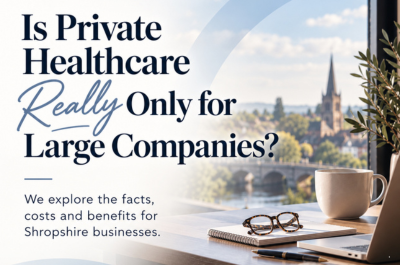
One of the most persistent myths in employee benefits is that private healthcare is something only large corporates can afford. Ask a room of SME owners whether health cover is realistic for a business of eight or fifteen people and most will assume it isn't, often without ever having asked the question properly.
It is worth understanding where that assumption comes from, and why it no longer reflects the market.
Where the myth comes from
For a long time it was broadly true. Private medical insurance grew up as a senior executive perk, sold to large employers with big headcounts and HR departments to administer it. If you ran a small business, you were unlikely to be offered it, and the products on the market weren't designed around you.
That has changed considerably. Most insurers now write group schemes from two or three employees, and cover for a single director is widely available. The administration has largely moved online. What was once a corporate-only product is now sold, in volume, to businesses the size of most Chamber members.
The national picture reflects that shift. The latest figures from the Association of British Insurers show 6.5 million people in the UK covered by private medical insurance, of whom 4.8 million are covered through a workplace scheme — the highest level in more than thirty years of data collection. Insurers paid out a record £4 billion in claims, equivalent to around £11 million every day.
Those are not all FTSE companies. A great many are firms of ten, twenty or thirty people who decided the question was worth asking.
What it actually costs
This is where most conversations stall, usually because nobody has put a number on it.
For health cash plans, the long-standing benchmark in the employer-paid market is around £1 per employee per week. Entry-level company-paid plans commonly start somewhere around £5 per employee per month, and independent market data puts the average employer-paid cash plan at roughly £94 to £100 per employee per year. These plans don't fund surgery; they reimburse everyday costs such as dental, optical, physiotherapy and prescriptions, and usually bundle a virtual GP service and an employee assistance programme.
For private medical insurance, broker market guides for 2026 put typical SME pricing somewhere between £35 and £110 per employee per month, with most mid-tier schemes landing in the middle of that range. The spread is wide because the premium depends on several things you can influence and several you can't: the average age of your team, where the business is based, the level of cover, which hospital list you use, the excess you accept and the underwriting basis.
That last point matters. Raising the excess, capping outpatient cover or choosing a regional hospital list rather than premium London access can move a quote substantially. A scheme that looks unaffordable in its fullest form is often perfectly affordable once it has been shaped around a real budget.
It is also worth knowing the tax treatment before you start. Premiums paid by the business are normally an allowable expense, but the cover is usually a benefit in kind for the employee, reported on a P11D, with Class 1A National Insurance for the employer. It isn't complicated, but it does need a conversation with your accountant rather than an assumption.
What employees make of it
Perceived value is the part employers consistently underestimate.
A cash plan costing a few pounds a month is a benefit an employee uses several times a year — they claim back a dental check-up, a pair of glasses, a course of physiotherapy. It is visible, repeatedly. Compare that to a pay rise of the same annual value, which disappears into a monthly payslip and is forgotten by March.
Research among HR decision-makers points the same way, with around half reporting improved employee satisfaction after introducing health support, and sizeable proportions citing reduced sickness absence and better retention. Independent analysis has also found cash plans return a high proportion of premiums as claims relative to other insurance products, which is a reasonable proxy for whether people actually use them.
For a smaller employer competing against larger firms on salary, that visibility is the point. You may not be able to match a corporate salary band. You can often match, or better, what the benefit actually feels like day to day.
Being straight about the limits
No benefit is right for every business, and it is worth being clear about what these products don't do.
Private medical insurance is designed for new, acute conditions. It does not cover emergencies, it does not manage long-term chronic conditions, and pre-existing conditions are normally excluded unless a specific underwriting basis is agreed. Premiums tend to rise at renewal as your team ages and medical costs inflate. Cash plans have annual limits and won't fund surgery.
Anyone who tells you this is a complete replacement for the NHS is overselling it. What it does is shorten the wait for diagnosis and treatment of the things it covers — which, as last month's article set out, is where a great deal of hidden cost sits for a small business.
The point
The honest answer to the question in the title is no, and it hasn't been yes for some years.
The more useful question for a Shropshire employer isn't whether healthcare is affordable for a business of your size. It's what shape it would need to take to be worth the money in your particular circumstances — and whether the version that fits your budget would actually do anything useful for your team.
That's a twenty-minute conversation and a quote, not a leap of faith. Most businesses that assume the answer is no have never had either.
________________________________________
Tom Davies runs Severn Private Health, a WPA Healthcare Practice covering Shropshire and Powys, helping businesses, families and individuals access healthcare and employee benefits solutions. This is the second article in the Healthcare Matters series for Shropshire Chamber members. If you're a fellow Chamber member and would like to discuss any of the issues raised, Tom is always happy to have an informal conversation with no obligation.
Figures quoted are general market information, not a quotation or personal advice. Sources: Association of British Insurers private medical insurance data, 2024; LaingBuisson health cover market data; Employee Benefits buyers' guide to health cash plans; published 2026 SME broker pricing guides.



Latest News